Released in 1969, Five Leaves Left is the monumental debut album by English singer-songwriter Nick Drake, introducing a visionary talent whose delicate, haunting folk songs would go on to profoundly shape generations of acoustic music. Recorded while Drake was still an English Literature student at Cambridge, the album's cryptic title derived from a warning printed on Zig-Zag rolling paper packets ("Only five leaves left"). Across timeless masterpieces like "Way to Blue," "River Man," "Cello Song," and "Day Is Done," the record explores themes of melancholy, urban detachment, fleeting time, and quiet existential beauty with astonishing maturity and poetic grace.
Sonically, the album is a masterclass in acoustic elegance, intimate chamber folk, and lush, organic spatial depth, produced by Joe Boyd inside London's Sound Techniques studio. The record is driven by Drake's extraordinary acoustic guitar technique—a complex, fingerpicked tapestry of cluster chords, non-standard tunings, and intricate polyrhythms that lock in with Danny Thompson's deep, woody upright bass notes and Tristan Fry's subtle, brushed percussion. Floating through these pastoral folk structures are the sweeping, cinematic string arrangements of Robert Kirby and Harry Robinson, which lend a dark, impressionistic weight to the compositions. Centered softly in the mix, Drake's voice is hushed, velvet-toned, and intimate—singing with a breathy, unhurried warmth that feels as if he is whispering directly into the room.
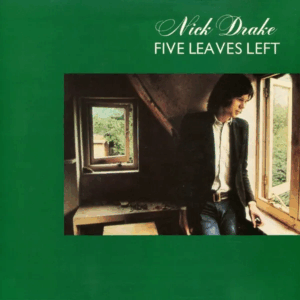
Released in 1969, Five Leaves Left is the monumental debut album by English singer-songwriter Nick Drake, introducing a visionary talent whose delicate, haunting folk songs would go on to profoundly shape generations of acoustic music. Recorded while Drake was still an English Literature student at Cambridge, the album's cryptic title derived from a warning printed on Zig-Zag rolling paper packets ("Only five leaves left"). Across timeless masterpieces like "Way to Blue," "River Man," "Cello Song," and "Day Is Done," the record explores themes of melancholy, urban detachment, fleeting time, and quiet existential beauty with astonishing maturity and poetic grace.
Sonically, the album is a masterclass in acoustic elegance, intimate chamber folk, and lush, organic spatial depth, produced by Joe Boyd inside London's Sound Techniques studio. The record is driven by Drake's extraordinary acoustic guitar technique—a complex, fingerpicked tapestry of cluster chords, non-standard tunings, and intricate polyrhythms that lock in with Danny Thompson's deep, woody upright bass notes and Tristan Fry's subtle, brushed percussion. Floating through these pastoral folk structures are the sweeping, cinematic string arrangements of Robert Kirby and Harry Robinson, which lend a dark, impressionistic weight to the compositions. Centered softly in the mix, Drake's voice is hushed, velvet-toned, and intimate—singing with a breathy, unhurried warmth that feels as if he is whispering directly into the room.