Released in 2016, Hawniyaz is a mesmerizing, cross-cultural masterpiece that bridges the rich musical traditions of Kurdish, Turkish, and Azerbaijani heritage into a cohesive, chamber-folk tapestry. Bringing together four masters of Eastern music—Kurdish kamancheh virtuoso Kayhan Kalhor, revered Kurdish-Turkish vocalist Aynur Doğan, Azerbaijani jazz pianist Salman Gambarov, and Kurdish tenbûr player Cemîl Qoçgiri—the album’s title translates from Kurdish to "Together" or "Standing Together." Moving through traditional folk melodies, improvisational dialogues, and reinvented regional classics like "Ahmedo" and "Malê Min," the project serves as a poignant exploration of displacement, cultural resilience, shared history, and profound spiritual longing.
Sonically, the record is an exquisite study in acoustic spatial resonance, dynamic delicacy, and microtonal harmony. The instrumentation balances the earthy, bowed rasps of Kalhor’s kamancheh and the woody, plucked precision of Qoçgiri’s tenbûr against the unexpected, fluid classical-jazz harmonic foundation of Gambarov’s grand piano. Recorded with exceptional clarity, the mix offers a wide, three-dimensional soundstage where every instrument occupies its own distinct acoustic space—from the resonance of the piano's lower register to the delicate, ringing sustain of the tenbûr strings. Hovering above these intricate, hypnotic arrangements is Aynur’s extraordinary voice: powerful, raw, and deeply emotive, her singing shifts effortlessly between mournful, breathy ornamentation and soaring, full-throated laments that vibrate with intense, transcendent soulfulness.
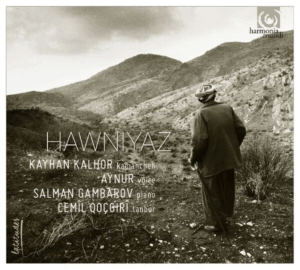
Released in 2016, Hawniyaz is a mesmerizing, cross-cultural masterpiece that bridges the rich musical traditions of Kurdish, Turkish, and Azerbaijani heritage into a cohesive, chamber-folk tapestry. Bringing together four masters of Eastern music—Kurdish kamancheh virtuoso Kayhan Kalhor, revered Kurdish-Turkish vocalist Aynur Doğan, Azerbaijani jazz pianist Salman Gambarov, and Kurdish tenbûr player Cemîl Qoçgiri—the album’s title translates from Kurdish to "Together" or "Standing Together." Moving through traditional folk melodies, improvisational dialogues, and reinvented regional classics like "Ahmedo" and "Malê Min," the project serves as a poignant exploration of displacement, cultural resilience, shared history, and profound spiritual longing.
Sonically, the record is an exquisite study in acoustic spatial resonance, dynamic delicacy, and microtonal harmony. The instrumentation balances the earthy, bowed rasps of Kalhor’s kamancheh and the woody, plucked precision of Qoçgiri’s tenbûr against the unexpected, fluid classical-jazz harmonic foundation of Gambarov’s grand piano. Recorded with exceptional clarity, the mix offers a wide, three-dimensional soundstage where every instrument occupies its own distinct acoustic space—from the resonance of the piano's lower register to the delicate, ringing sustain of the tenbûr strings. Hovering above these intricate, hypnotic arrangements is Aynur’s extraordinary voice: powerful, raw, and deeply emotive, her singing shifts effortlessly between mournful, breathy ornamentation and soaring, full-throated laments that vibrate with intense, transcendent soulfulness.